Marketing Materials
Rack Card Size & Dimensions: The 4×9 Print and Design Guide
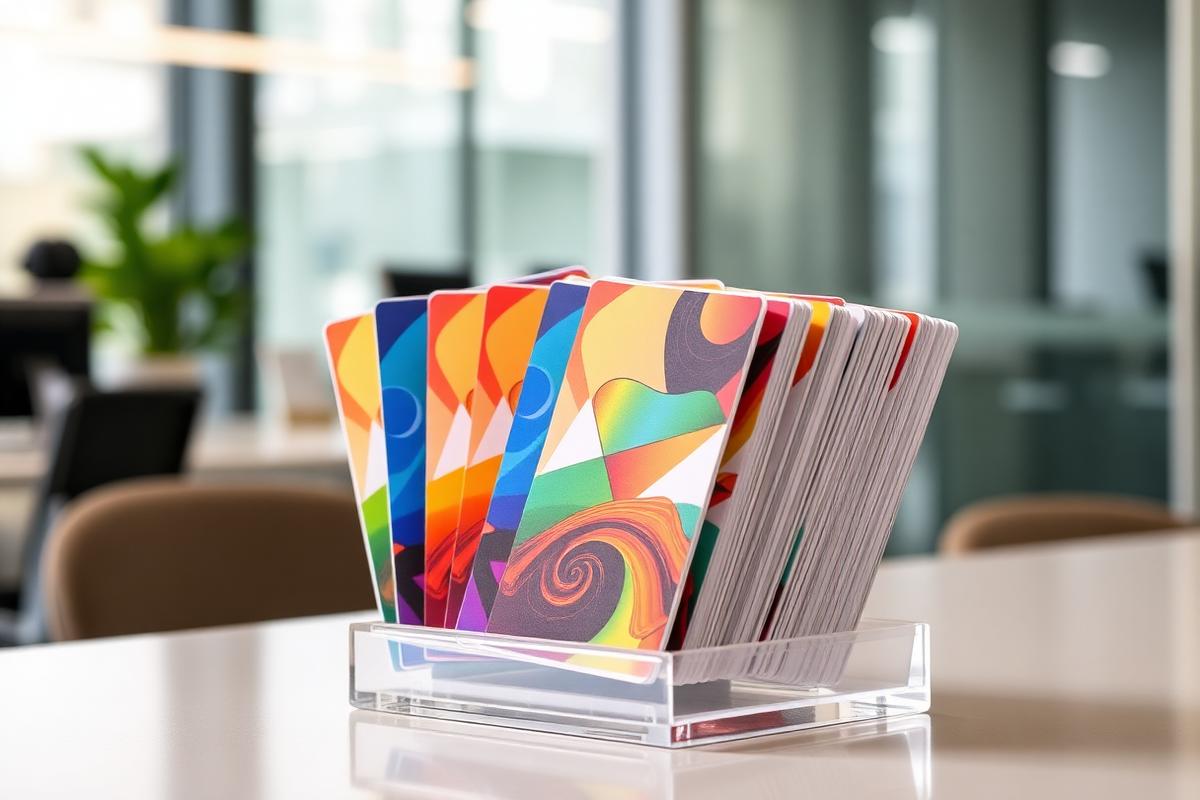
A rack card is a single, two-sided printed card made to stand upright in brochure displays. The standard size is 4 × 9 inches, which fits the racks found in hotels, visitor centers, restaurants and local attractions. Businesses use the front for one clear offer and the back for prices, directions, contact details or a QR code.
This guide explains rack card dimensions and bleed, compares paper stocks, shows what information belongs on each side and covers practical distribution and tracking. It also explains when a rack card is a better fit than a folded brochure.
What is a rack card?
A rack card is a two-sided printed card, usually 4" x 9", designed to stand upright in brochure racks and display stands. Businesses use rack cards to promote one offer, attraction or service in hotels, visitor centers, waiting rooms and shop counters.
Standard rack card size and dimensions
The standard rack card size is 4" x 9" (101.6 x 228.6 mm). Print files need 0.125" bleed on every side, so the document size is 4.25" x 9.25". Keep text and logos inside the 3.75" x 8.75" safe area. A 4 x 9 rack card also fits a #10 business envelope without folding.
| Measurement | Inches | Millimeters | Pixels at 300 DPI |
|---|---|---|---|
| Trim size (final card) | 4" x 9" | 101.6 x 228.6 mm | 1200 x 2700 px |
| Document size with bleed | 4.25" x 9.25" | 107.95 x 234.95 mm | 1275 x 2775 px |
| Safe area (keep text inside) | 3.75" x 8.75" | 95.25 x 222.25 mm | 1125 x 2625 px |
Order custom rack card printing
Ready to print? We produce custom 4 x 9 rack cards in Boston on 14 pt and 16 pt coated stock with gloss, matte and UV finishes, with live pricing by quantity and free shipping on orders over $75.
Why 4x9 rack cards beat brochures
A tri-fold brochure asks the reader to unfold it, scan multiple panels, and figure out where to look first. A rack card gives them a single front panel to react to and a single back panel for details. Less friction, higher read-through.
Rack cards also fit the physical infrastructure of the places you want to be displayed. Standard 4 x 9 racks are everywhere; oversized brochures don't fit and get pulled. If you want to be in a hotel lobby or a visitor center, the 4 x 9 size is table stakes.
Production is faster and per-piece cost is lower, which means you can print more, distribute more widely, and refresh the design more often without breaking your marketing budget.
Ideal use cases
Tourism and attractions get the most out of rack cards. A well-designed card in a hotel lobby is essentially a warm lead — the guest is already looking for something to do that day.
Restaurants use rack cards for takeout menus, happy-hour specials, and event nights. The single-page format works well for menus that need to be scanned in seconds.
Service businesses — spas, salons, tour operators, real-estate agents, gyms — use rack cards as leave-behinds at partner locations. A card in the right rack outperforms a boosted social post because it reaches people at the moment of decision.
Rack card examples for tourism and hospitality
A tour operator can use a strong destination photo and a short booking message on the front, then put departure times, prices, the meeting point and a location-specific QR code on the back. Giving each hotel or visitor center a different code makes those displays measurable.
A restaurant can use a slim rack card as a compact takeout menu. A clearly stated offer gives hotel staff a reason to hand it to guests, while a redemption code shows whether the placement produces visits.
A spa or attraction can create a partner card for nearby hotels, with the main experience on the front and a hotel-specific guest offer on the back. The card works best when the benefit to the visitor is immediately visible.
How to run a rack card campaign, step by step
1. Pick one offer and one action. A rack card that tries to say everything gets ignored. Decide the single thing you want the reader to do — book, call, visit, scan — and build the card around it.
2. List 20–30 locations where your customers already wait or browse: hotel lobbies, visitor centers, coffee shops near your pickup point, complementary businesses. Ask in person; a two-minute conversation gets a yes far more often than an email.
3. Print a first run of 1,000–2,500 cards. That is enough to stock every location with 50–100 cards and hold a reserve for restocking, without committing to a design you have not tested.
4. Assign each location its own QR code or coupon code before the cards ship. This is the only way you will know which racks produce customers and which just consume cards.
5. Restock and review monthly. Pull cards from locations with zero scans after 90 days and redirect that stock to the racks that perform. Refresh the design seasonally — a card that mentions a summer special in November gets pulled by the location.
5 design rules that get rack cards picked up
Lead with a photo, not a logo. The front panel has one job: make someone reach for it. A strong lifestyle or product image beats a headline nine times out of ten.
Put the offer and the call to action above the fold. On a 4 x 9 card, that usually means the top third of the front panel. QR codes work well here — they turn a printed card into a measurable, trackable channel.
Reserve the back panel for the details: pricing, hours, address, phone, website, and a map or short list of features. Keep the layout clean and use plenty of whitespace so the card doesn't feel cluttered when read at arm's length.
Choose a coated 14 pt or 16 pt stock. Rack cards get handled, stacked, and shuffled — thin uncoated stock curls and looks tired within a week.
Where to distribute rack cards (and how to track results)
Start with hotels, motels, and short-term-rental hosts in your area. Most have a lobby rack and will accept cards from local businesses for free or a small monthly fee.
Visitor centers, chambers of commerce, and welcome centers are second-priority locations. They usually curate what they display, so lead with quality — a professionally designed card is more likely to make the rack.
Cross-promote with complementary businesses. A tour operator's cards belong in restaurants and coffee shops near their pickup point; a spa's cards belong at gyms, hair salons, and boutique hotels.
Track performance with unique QR codes or coupon codes per location so you know which racks are actually driving customers.
Rack card sizes and specs at a glance
Rack cards are ordered by trim size, and the size decides which racks will actually hold your card. Build every file at trim size plus 0.125" bleed on all four sides, keep text 0.125" inside the trim, and supply 300 DPI CMYK artwork.
| Trim size | Document size with bleed | Also called | Best for |
|---|---|---|---|
| 4" x 9" | 4.25" x 9.25" | Standard rack card | Brochure racks, #10 envelope inserts, mailers |
| 3.5" x 8.5" | 3.75" x 8.75" | Slim rack card | Tight rack pockets, lowest cost per piece |
| 4" x 7" | 4.25" x 7.25" | Short rack card | Counter cards and handouts |
| 4.25" x 11" | 4.5" x 11.25" | Oversized rack card | Real-estate sheets, service menus |
Paper stock and finish comparison
Stock choice matters more on a rack card than on almost any other printed piece, because the card has to stand upright unsupported for weeks. Anything under 12 pt slumps forward in the rack and hides your headline.
| Stock | Feel | Best finish | Use it when |
|---|---|---|---|
| 14 pt C2S | Standard, rigid enough to stand | Gloss or matte | High-volume distribution on a budget |
| 16 pt C2S | Noticeably stiffer, premium | Matte or soft-touch | Hotel lobbies and high-end retail racks |
| 100# gloss cover | Lighter, photo-friendly | UV gloss | Image-led tourism and restaurant cards |
| Uncoated cover | Writable, natural | None | Appointment times, coupon codes, handwriting |
What rack cards cost and how fast you get them
Rack cards are priced by size, stock and run length, so the per-piece cost drops sharply as the quantity goes up — a 5,000-piece run on 14 pt coated stock costs far less per card than 250 pieces of the same design. Live pricing for every size and stock combination shows on the product page as you pick options.
On turnaround: standard pieces we run in Boston print same or next business day, with one to six business days in transit depending on where they're going. Larger or more complex runs sent to our production partners typically take four to eight business days before shipping. Shipping is free on orders over $75.
Order rack cards and related pieces
We print rack cards in Boston on 14 pt and 16 pt coated stock with gloss, matte, and UV options, and we can design the piece if you only have a logo and a list of services.
Frequently asked questions
- What is the standard rack card size?
- The standard rack card size is 4 x 9 inches. This is the size that fits the countertop and wall-mounted display racks you see in hotels, visitor centers, and lobbies.
- What is a rack card?
- A rack card is a two-sided printed card, usually 4 x 9 inches, made to stand upright in brochure racks. It promotes one offer, attraction or service in places like hotels, visitor centers and waiting rooms.
- What are rack card dimensions in inches, mm and pixels?
- A standard rack card trims to 4 x 9 inches (101.6 x 228.6 mm), or 1200 x 2700 pixels at 300 DPI. With 0.125 inch bleed the file is 4.25 x 9.25 inches (1275 x 2775 pixels).
- Why are rack cards 4 x 9 inches?
- Brochure racks are built for a folded letter-size sheet, which is about 4 x 9 inches. Rack cards match that size so they fit every standard display pocket and a #10 envelope.
- Are rack cards better than brochures?
- For most tourism, hospitality, and local service businesses, yes. Rack cards are cheaper to print, easier to read at a glance, and fit the standard display infrastructure — brochures often don't fit those racks and get pulled.
- What paper stock should I choose for rack cards?
- A coated 14 pt or 16 pt stock is the sweet spot. It's thick enough to feel substantial and to hold up in a busy rack, but affordable enough for high-volume distribution.
- How much bleed does a rack card need?
- Use 0.125 inches (1/8") of bleed on all four sides and keep text at least 0.125 inches inside the trim line. For a 4 x 9 card that means a 4.25 x 9.25 inch document with a 3.75 x 8.75 inch safe area, supplied at 300 DPI in CMYK.
- Can rack cards be mailed?
- Yes. A 4 x 9 rack card mails as a standard flat insert or postcard-size piece in most cases, which makes it a common dual-purpose piece for rack distribution and direct mail campaigns.
- How much do rack cards cost to print?
- Cost depends on trim size, stock, coating, and quantity, and the per-piece price falls sharply between 500 and 5,000 pieces. Send us the size, stock, and two or three quantities and we'll quote them side by side, usually within one business day.