Design & Prepress
Demystifying Paper Weight: 14pt, 16pt, 100lb, and GSM Explained
Navigating a print specification sheet can be frustrating when you encounter terms like 100lb Text, 100lb Cover, 16pt, and 350 GSM alongside one another. To someone outside the printing industry, a higher number intuitively suggests a thicker sheet. In practice, evaluating paper weight based solely on numbers without understanding the unit of measurement often leads to unexpected results, such as ordering flimsy postcards or heavy brochures that resist folding cleanly.
Selecting the right substrate directly influences how customers perceive your business. A business card that bends under slight thumb pressure feels disposable, while a trifold brochure printed on overly rigid cardstock may crack at the spine or refuse to lie flat on a counter. By understanding the mechanical differences between basis weight, caliper, and metric density, you can eliminate guesswork, protect your marketing budget, and ensure your finished products perform as intended.
Caliper vs. Weight: The Core Difference
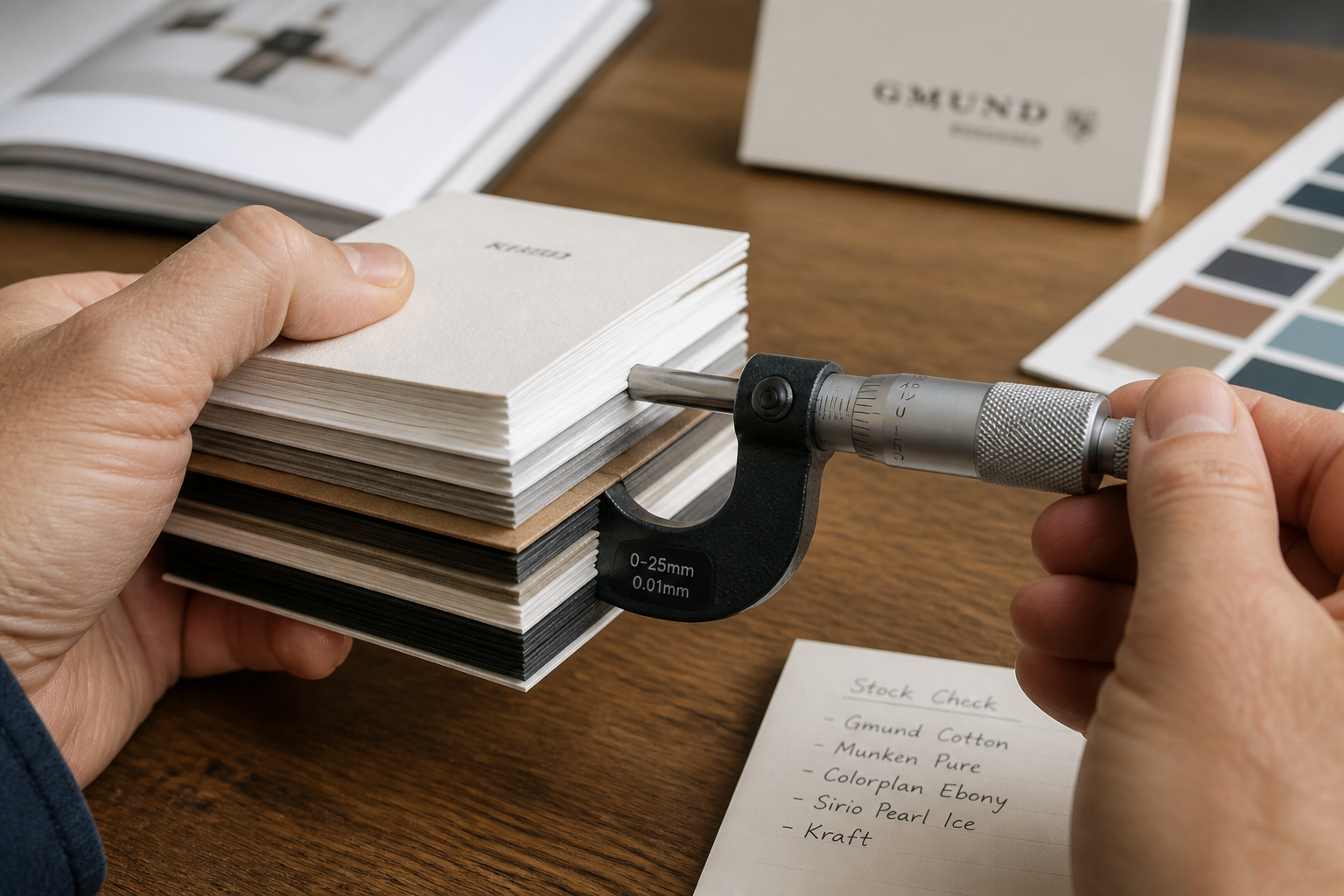
The first distinction to master is the difference between how thick a paper is and how much it weighs. Caliper measures thickness directly using thousandths of an inch, typically expressed as 'points' (pt). One point equals 0.001 inches. Therefore, a 14pt stock measures 0.014 inches thick, and a 16pt stock measures 0.016 inches thick. Caliper is an objective physical measurement of distance from one surface of the sheet to the other.
Weight, on the other hand, measures the mass of a defined volume of paper. In North America, this is typically expressed as basis weight in pounds (lb), while international standards rely on grams per square meter (GSM). Because paper fibers can be compacted tightly or left loose and bulky during manufacturing, two different sheets can share the exact same thickness while having different weights, or share the same weight while differing in thickness.
For example, a heavily compressed, ultra-smooth coated sheet might weigh more than an uncalendered, rough linen sheet of the exact same caliper. When rigidity and tactile presence are your primary goals—such as with business cards or retail tags—caliper is often the more informative metric to review.
The Basis Weight Trap: Text Stock vs. Cover Stock
The most common source of confusion in US commercial printing is the pound (lb) rating. A buyer might assume that 100lb Text and 100lb Cover are equivalent stocks, but they are dramatically different. A 100lb Text sheet is flexible paper commonly used for premium brochure pages, while a 100lb Cover sheet is rigid cardstock suitable for booklet covers or greeting cards.
This discrepancy exists because US basis weight is calculated by weighing 500 uncut sheets (a ream) of paper at its industry-standard 'parent sheet' size. The manufacturing parent size for Text (or Book) paper is 25 by 38 inches. The parent size for Cover paper, however, is much smaller at 20 by 26 inches. Because 500 sheets of the smaller cover size still weigh 100 pounds, individual sheets of 100lb Cover are significantly denser and roughly twice as thick as 100lb Text.
Whenever you see a weight listed in pounds, always verify whether the manufacturer designates it as Text, Book, Bond, or Cover. Assuming all 'pounds' are equal is the primary reason buyers accidentally order paper that is either far too limp or too heavy for their machinery.
Points (pt): The Standard for Cards and Heavy Mailers
Commercial printers in North America typically quote business cards, presentation folders, door hangers, and heavy postcards in points rather than pounds. The standard baseline for commercial cardstock starts at 14pt. A 14pt sheet provides sufficient rigidity to pass through postal sorting machines without tearing and maintains a professional feel in hand.
Moving up to 16pt provides noticeable firmness. A 16pt card does not flex easily under normal handling, which makes it the standard choice for professional business cards, retail counter displays, and durable promotional inserts. For premium applications, specialty stocks can reach 18pt, 24pt, or even 32pt through multi-ply sandwich pasting.
Keep in mind that surface coatings and laminations alter caliper. Adding a 1.5-mil soft-touch laminate or a heavy gloss finish to both sides of a 16pt sheet increases its final thickness closer to 18pt or 19pt, while adding substantial structural rigidity and tear resistance.
GSM: The Global Metric Standard
Because the North American basis weight system relies on arbitrary parent sheet sizes that change by paper category, international markets use grams per square meter (GSM). GSM measures the exact weight in grams of a single square meter of the paper, regardless of how the mill cuts or packages it.
GSM provides an apples-to-apples comparison across every category of paper. A 300 GSM sheet is always heavier and denser than a 150 GSM sheet, whether the paper is intended for stationary, books, or folding cartons. For this reason, modern digital press manufacturers and international suppliers almost exclusively calibrate their equipment specifications in GSM.
As a quick frame of reference: standard 20lb office copy paper sits around 75 GSM. High-end catalog interiors printed on 100lb Text sit near 148 GSM. A standard 14pt cardstock converts roughly to 308 to 350 GSM depending on the coating and fiber density, while a 16pt sheet typically falls between 350 and 400 GSM.
Matching the Right Stock to Your Project
Selecting paper involves balancing aesthetics, functionality, mailing rules, and budget. For folded collateral like trifold brochures, menus, and flyers, 80lb Text or 100lb Text is standard. These weights hold vibrant ink coverage, resist show-through from the reverse side, and fold cleanly without requiring mechanical scoring.
Direct mail postcards, including Every Door Direct Mail (EDDM) pieces, require careful attention to thickness. The United States Postal Service enforces a strict minimum thickness of 0.007 inches (7pt) for machinable postcards, with 0.009 inches (9pt) required for pieces exceeding certain dimensions. While 100lb Cover meets postal minimums, using 14pt or 16pt stock ensures your mailers withstand automated high-speed sorting equipment without bent corners or surface scuffs.
For multi-page publications such as catalogs and annual reports, a self-cover design uses the same text stock (often 80lb or 100lb Text) throughout the entire piece. A plus-cover configuration upgrades the exterior sheet to an 80lb or 100lb Cover stock, providing a protective shell that protects interior pages during shipping and handling.
Frequently asked questions
- Why is 100lb Cover thicker than 100lb Text?
- Basis weight in the US is determined by weighing 500 sheets of paper at their uncut parent size. Because the standard parent size for Text paper is 25x38 inches and Cover paper is 20x26 inches, 500 sheets of the smaller cover size must be much thicker and denser to weigh the same 100 pounds.
- What is the minimum paper weight required for USPS EDDM postcards?
- The USPS requires standard postcards to be at least 0.007 inches thick, and pieces larger than standard letter size must be at least 0.009 inches thick. In practice, reputable commercial printers run EDDM orders on 14pt (0.014 inches) or 16pt (0.016 inches) stock to ensure compliance and avoid transit damage.
- Can I run 16pt cardstock through a standard desktop printer?
- Most office and home desktop printers cannot handle 16pt cardstock. Standard office laser and inkjet feed paths are designed for stocks up to approximately 65lb to 80lb Cover (around 10pt to 11pt), and feeding heavier stock typically results in paper jams, surface roller scuffs, or incomplete toner fusing.
- Does adding UV coating or lamination change the paper weight?
- Yes. A liquid UV coating adds negligible weight and thickness, but film laminations—such as gloss, matte, or soft-touch—typically add 1.0 to 1.5 mils (0.001 to 0.0015 inches) per side. Applying film to both sides of a 16pt card effectively raises the finished caliper to roughly 18pt or 19pt.