Business Cards
Business Card Finishes: Silk, Matte, and Gloss Compared
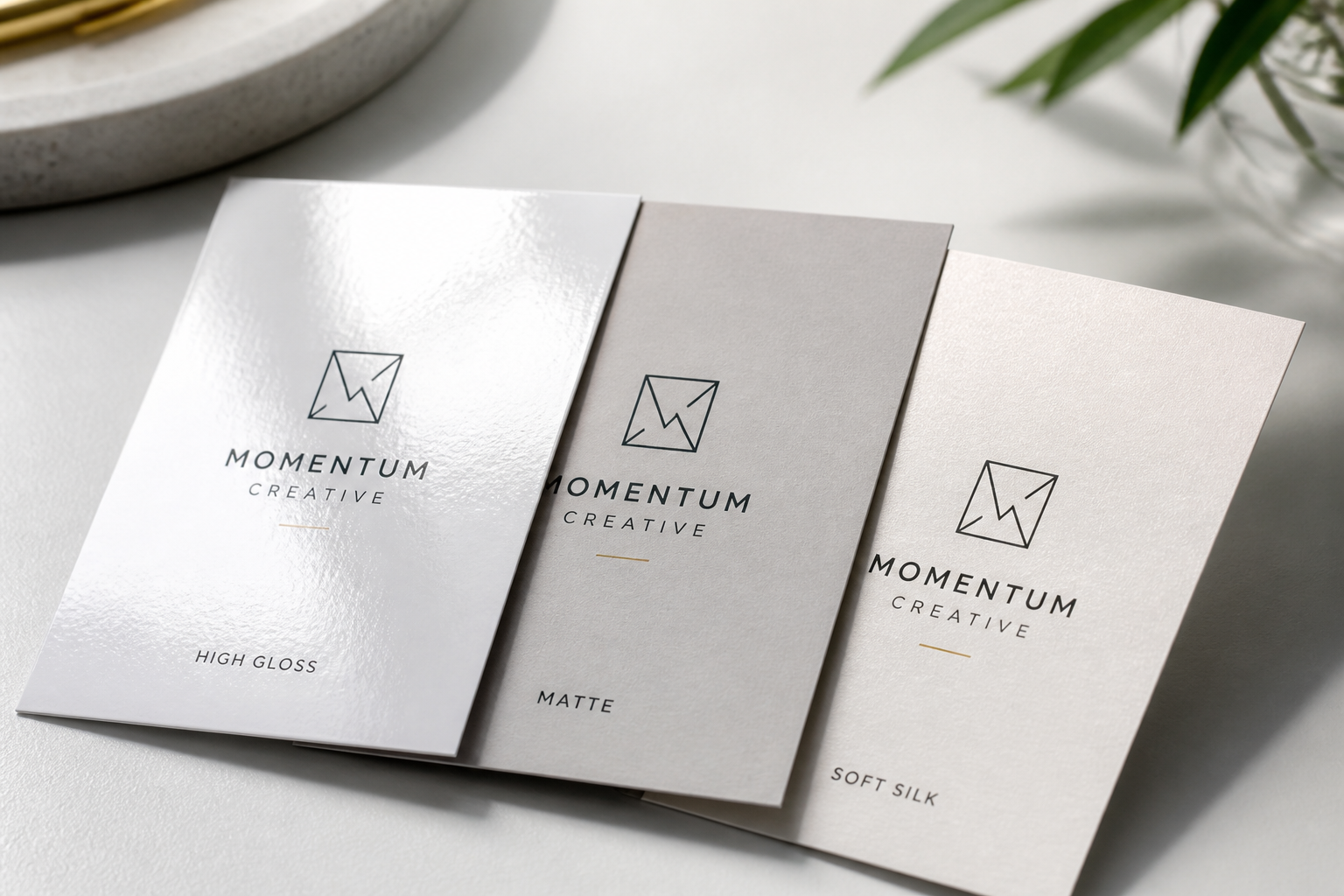
A business card is often the first physical touchpoint a potential client has with your brand. Beyond the design and information, the tactile experience it offers plays a significant role in perception. The finish of your business card affects its durability, aesthetic appeal, and how it feels in hand, influencing the lasting impression you make.
Selecting the appropriate finish is not merely a stylistic choice; it's a strategic decision that aligns with your brand identity and the message you want to convey. This article will deconstruct the characteristics of silk, matte, and gloss finishes, providing a clear understanding of their benefits and suitable applications for small business owners and marketing managers.
Gloss Finish: Vibrant and Eye-Catching
A gloss finish delivers a highly reflective, shiny surface, often achieved with a UV coating. This finish makes colors appear more vibrant and saturated, enhancing the visual pop of your design. The reflective quality can draw immediate attention, making it suitable for businesses that want to convey energy, innovation, or a bold aesthetic.
Beyond its visual appeal, a gloss finish provides a protective layer, increasing the card's durability and resistance to moisture and smudges. This makes it a practical choice for cards that may experience frequent handling. However, the high reflectivity can sometimes cause glare, potentially making small text harder to read in certain lighting conditions. Fingerprints are also more apparent on a gloss surface.
Matte Finish: Subtlety and Sophistication
In contrast to gloss, a matte finish offers a non-reflective, smooth surface with a muted appearance. This finish absorbs light rather than reflecting it, resulting in a subdued elegance. Colors on a matte card appear softer, providing a sophisticated and understated aesthetic. It's often chosen by brands aiming for a classic, professional, or high-end image.
Matte cards are excellent for designs with ample white space or lighter color palettes, as they prevent glare and improve readability. They feel smooth to the touch, contributing to a premium perception. While generally more resistant to fingerprints than gloss, matte finishes can be slightly more susceptible to scuffing and show minor abrasions over time if not handled carefully. They do not offer the same level of moisture resistance as a UV-coated gloss card.
Silk Finish: Durability with a Soft Touch
A silk finish, also known as silk lamination, strikes a balance between gloss and matte. It involves applying a thin, film-like laminate to the cardstock, resulting in a surface that is smooth, soft to the touch, and possesses a subtle sheen, not a high reflective gloss. This finish combines the best attributes of both, offering a sophisticated look without the extreme reflectivity of gloss or the sometimes delicate nature of matte.
The silk lamination process significantly enhances the card's durability. It makes the card resistant to tearing, creasing, and water, offering superior longevity compared to uncoated or standard matte finishes. The unique texture creates a memorable tactile experience, often perceived as luxurious and high-quality. Colors on a silk finish appear rich and well-defined, providing a balance of vibrancy and subtlety. This finish is a strong choice for brands that prioritize both elegance and resilience.
Choosing the Right Finish for Your Brand
The optimal finish depends on your brand's personality and the message you wish to convey. For creative industries, event planners, or businesses focused on visual impact, a gloss finish might be suitable due to its vibrant color rendition. For financial services, law firms, or luxury brands, a matte finish often aligns better with an image of professionalism and understated quality. If your brand balances modern aesthetics with traditional values, or if card longevity is a primary concern, a silk finish is often an excellent middle ground.
Consider also the design elements of your card. High-contrast designs with bold colors may pop more with gloss, while minimalist designs with fine typography might benefit from the readability and sophistication of matte or silk. If your design includes photography, a gloss or silk finish can enhance image quality. For any finish, ensuring the underlying cardstock is of appropriate weight (e.g., a substantial 16pt or 18pt) will further contribute to a sense of quality and durability.
Practical Considerations for Printing
When working with a commercial print shop like Odd Jobs Media, discussing your finish options is a key step. The chosen finish can impact how ink appears and how the card withstands daily use. For instance, some finishes are better suited for specific printing techniques or incorporate elements like spot UV or foil stamping. A silk finish, for example, provides a stable and smooth base for various embellishments.
It is also important to consider the writeability of the card if that is a necessary function. Matte finishes are generally the easiest to write on with various pens. Silk finishes can be written on with most ballpoint pens, but permanent markers are often recommended for best results. Gloss finishes, particularly those with a heavy UV coat, are typically difficult to write on with anything other than a permanent marker, and even then, results can vary. For applications requiring notes or appointments, this usability factor is crucial.
Frequently asked questions
- Which business card finish is the most durable?
- A silk laminated finish is typically the most durable option. The lamination film provides significant resistance to tearing, creasing, water, and general wear, outperforming standard matte or gloss UV-coated cards in longevity.
- Can I write on all business card finishes?
- No. Matte finishes are the easiest to write on. Silk finishes can be written on with many pens, though permanent markers are often best. Gloss finishes, especially those with heavy UV coating, are generally difficult to write on effectively with standard pens; permanent markers are usually required, but results may still be inconsistent.
- Does the finish affect print quality or color accuracy?
- Yes, the finish significantly impacts how colors appear. Gloss enhances color vibrancy and saturation, while matte subdues colors for a softer look. Silk offers a balance, making colors appear rich and well-defined. It's always advisable to view printed samples or digital proofs that simulate the chosen finish to ensure color accuracy meets expectations.